Complete guide to web development services for businesses in Jordan & Saudi Arabia. Custom vs template comparison, scope breakdown, tech stack explained, and how to choose the right agency.
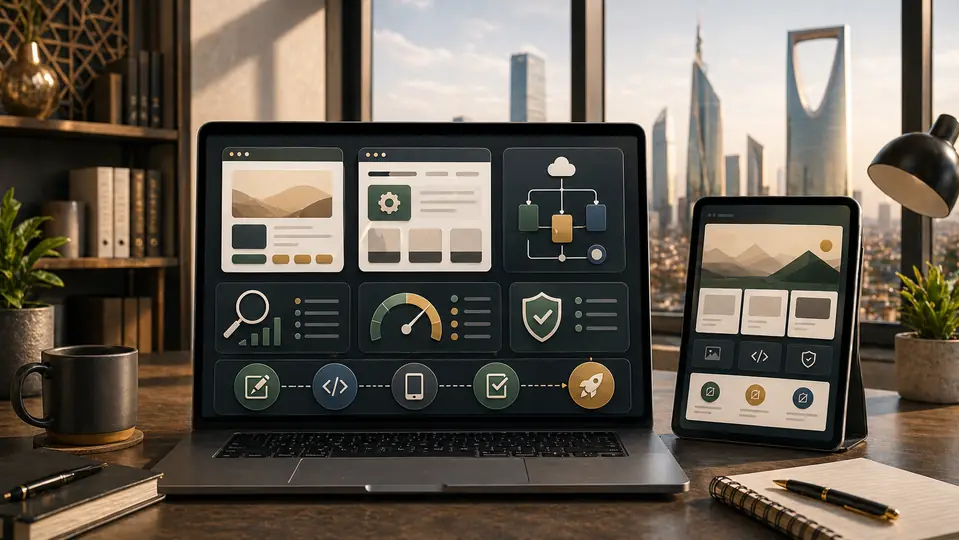
Web Development Services That Empower Your Online Presence
A business website has a fixed set of jobs to do: load fast, explain the offer, support Arabic-English users, integrate tools, handle forms or payments, rank in search, and convert visitors. Custom beats templates when performance, ownership, integrations, or scale matter, which is the case Ijjad builds every web development project around.
- Ijjad serves Amman, Riyadh, Jeddah, Iraq, and the GCC.
- Every recommendation is framed around scope, conversion, and search visibility.
- Use the guide to clarify decisions before speaking with an agency.
- Talk to Ijjad when you need senior delivery, not generic templates.
A website should be judged by the work it performs for the business: helping the right buyer understand the offer, complete a useful action, and return to a maintainable experience. That outcome depends on strategy, content, implementation, demand, measurement—not a universal UX return statistic.
Professional web development can support acquisition, sales, operations, customer service when the build matches a real business need. The right investment depends on the product, current bottleneck, internal capacity, and measurable outcomes.
This guide breaks down exactly what professional web development services include, how to choose the right approach for your business, what it scopes in Jordan and Saudi Arabia, and how to make sure your investment actually pays off.
What a Professional Build Should Make Verifiable
Use your own analytics and field data to judge business impact.
In This Guide:
- 1. What Are Web Development Services? (Beyond Just "Building a Website")
- 2. 6 Types of Web Development Services Your Business May Need
- 3. Custom Development vs. Templates: The Honest Comparison
- 4. Modern Tech Stack: What Powers Today's Best Websites
- 5. The Professional Development Process (Step by Step)
- 6. Web Development Scopes in Jordan & Saudi Arabia
- 7. How to Choose the Right Web Development Agency
- 8. FAQ
What Are Web Development Services? Beyond Just "Building a Website"
When business owners hear "web development services," most think of someone writing code to make a website appear on the internet. The reality is much bigger than that.
Professional web development is a complete discipline that covers strategy, design, engineering, optimization, ongoing growth. A website built right isn't just a digital brochure — it's a lead-generating, trust-building, revenue-driving machine that works 24/7.
Here's what modern web development services actually include:
Strategic planning — understanding your business goals, target audience, and competitor picture before writing a single line of code. This is where most template websites fail: they skip strategy entirely.
UI/UX design — creating interfaces that are visually appealing and intuitive to use. Remember, visitors judge your credibility by your website's design before they read a word alone.
Frontend development — coding what users see and interact with. This shapes mobile responsiveness, accessibility, performance. Measure field performance and qualified actions on your own site rather than assigning a universal conversion loss to a timing change.
Backend development — the server-side logic that powers dynamic features like contact forms, user accounts, payment processing, and content management systems.
SEO architecture — building technical SEO foundations into the code from day one, not bolting them on as an afterthought. Proper heading structure, clean URLs, fast loading, mobile-first indexing — all of this starts at the development level.
Deployment and maintenance — launching the site on reliable hosting, setting up SSL security, configuring analytics, and providing ongoing updates and support.
6 Types of Web Development Services Your Business May Need
Not every business needs the same type of website. A restaurant in Amman has very different requirements than a government agency in Riyadh. Understanding which type fits your needs saves you time, money, frustration.
Types of Web Development Services
Different businesses need different types of websites
The key is matching the website type to your business model. A consulting firm doesn't need e-commerce functionality. A retail brand probably doesn't need a portal with role-based access. Starting with clarity about what you need leads to better results and smarter spending.
A useful interface makes the next action clear, reduces avoidable friction, and gives the team measurable points to improve after launch.
Custom Development vs. Templates: The Honest Comparison
This is the first decision most business owners face: do I build a custom website from scratch, or use a template on platforms like WordPress, Wix, or Squarespace?
Both approaches have legitimate use cases. Here's a side-by-side comparison based on real performance data:
Custom Web Development vs. Template Websites
| Factor | Custom Development | Template / Builder |
|---|---|---|
| Design Uniqueness | ✅ Fully unique to your brand | Shared with thousands of sites |
| Page Speed | ✅ Page-specific budget and rendered testing | Depends on theme, plugins, scripts, hosting, content |
| SEO Performance | ✅ Optimized code & structure from day one | Bloated code, limited SEO control |
| Time to Launch | 4-12 weeks | ✅ 1-7 days |
| Upfront Scope | Higher upfront | ✅ Low upfront |
| Conversion Rate | ✅ Custom journeys can be measured and iterated | Depends on template fit and implementation |
| Scalability | ✅ Unlimited: grows with your business | Limited by template structure |
| Maintenance | Needs developer for changes | ✅ DIY drag-and-drop editing |
| Long-Term Fit | ✅ Best when requirements justify ownership and control | Best when speed and simplicity matter more than custom control |
Custom wins for businesses that need performance, conversions, growth. Templates win for speed and scope on day one.
When a template makes sense: You're a brand-new startup that needs an online presence this week, your scope is extremely limited, or you're testing a business idea and need a quick MVP.
When custom development wins: You need your website to rank on Google, your business depends on converting website visitors into leads, or you need any custom functionality beyond basic pages.
Custom development earns its place when integrations, workflows, language requirements, performance control, or maintainability justify the added scope. A template may be the better decision for a standard content need. Compare the options against your requirements and measure the outcome after launch.
If you're weighing these options for your business, Ijjad's web development team can walk you through the trade-offs specific to your industry and market. Sometimes a hybrid approach — starting with a structured template and migrating to custom as you grow — makes the most sense.
Modern Tech Stack: What Powers Today's Best Websites
You don't need to become a developer, but understanding the basic technology layers helps you evaluate proposals and ask better questions when hiring a web development agency.
Modern Web Development Tech Stack
The technologies behind high-performance business websites
Why this matters for your business: The tech stack directly impacts your website's speed, security, scalability, SEO performance. A site built on React and Next.js will consistently outperform one built on an outdated WordPress theme — in load time, in Google rankings, and in user experience.
For businesses in the GCC, tech choices matter for long-term performance and scalability. Next.js with Tailwind CSS is a strong choice for modern web design projects in Jordan and Saudi Arabia.
The Professional Development Process
Understanding the process helps you know what to expect, when to provide feedback, and how to stay involved without micromanaging. Here's how a professional agency approaches web development:
Professional Web Development Process
What to expect when working with a professional web development agency
Notice that launch isn't the finish line — it's the starting line. The best web development agencies treat your website as a living product that improves over time based on real data, not guesswork.
The discovery phase is particularly important. This is where a good agency asks questions that a template builder never would: Who is your ideal customer? What action do you want visitors to take? What objections do potential customers have? The answers to these questions shape everything from the layout to the copywriting to the CTA placement.
Web Development Scopes in Jordan & Saudi Arabia
Let's talk money. Scope for web development services varies widely, and for good reason — a 5-page corporate site is a fundamentally different project than a custom e-commerce platform with payment integration.
Here are realistic scope ranges based on the Jordan and Saudi Arabia market:
Web Development scope guide — Jordan & Saudi Arabia
Typical investment ranges for professional web development
Scopes are estimates. Get a personalized proposal →
Want a more precise estimate? Ijjad's contact form gives you a personalized scope based on your specific requirements — number of pages, features, timeline. Try it free.
What drives scope up: Custom illustrations and animations, complex e-commerce with multiple payment gateways, custom web applications with user authentication, extensive API integrations (ERP, CRM, maps), and multi-language support.
What keeps scopes reasonable: Using proven frameworks instead of building from scratch, having content ready before development starts, clear requirements documented upfront, and choosing an agency that specializes in your type of project.
How to Choose the Right Web Development Agency
Not all agencies are created equal. Here are the factors that actually matter when choosing a web development partner:
Portfolio relevance. Don't just look at whether their past work looks nice — look at whether they've built sites similar to what you need. A beautiful portfolio of fashion websites doesn't help if you need a government portal.
Technical capability. Ask what tech stack they use and why. Agencies still building everything on basic WordPress themes in 2026 are behind the curve. Look for modern frameworks (React, Next.js) and evidence of performance optimization.
Regional expertise. For businesses in Jordan and Saudi Arabia, your agency must understand local payment gateways and the cultural nuances that affect how your audience uses the web.
SEO knowledge. Ask how they handle technical SEO during development. If they say "we'll do SEO after the site is built," that's a red flag. SEO should be architected into the code from day one.
Post-launch support. The relationship shouldn't end at launch. Look for agencies that offer maintenance packages, performance monitoring, and growth-focused iterations.
Communication style. Do they explain things clearly? Are they responsive? Do they involve you in decisions at the right moments? The technical quality matters, but so does the working relationship.
Frequently Asked Questions
What web development services does a professional agency offer?
A full-service agency handles strategic planning, UI/UX design, frontend and backend development, CMS integration, API connections, SEO optimization, deployment, and ongoing maintenance. The best agencies also provide analytics setup, conversion optimization, and content strategy guidance.
How are web development services scoped in Jordan?
Professional web development in Jordan is scoped after a discovery call, from a starter website up to enterprise solutions. In Saudi Arabia, scope runs higher. The scope depends on features, complexity, custom functionality. Use our contact form for a scoped recommendation.
Should I choose custom development or a template?
Choose custom development when you need controlled architecture, integrations, bilingual UX, or product workflows that a template cannot support cleanly. Choose a template when speed, simplicity, a standard content model matter more. Neither approach guarantees a PageSpeed score, ranking, conversion rate, or return.
How long does it take to develop a professional website?
Basic informational websites take 2-4 weeks. Professional sites with CMS and advanced features take 4-8 weeks. Complex e-commerce platforms or web applications typically require 8-12 weeks. The timeline depends largely on how quickly content and feedback are provided during the process.
Do I need a mobile-responsive website?
Yes, and it is the default, not an option. Mobile devices carry 70.21% of web traffic in Jordan, 59.57% in Saudi Arabia and 57.08% in Iraq (StatCounter, August 2026). Google also uses mobile-first indexing, meaning your mobile site is what determines your search rankings. Every professional web development project should be mobile-first by default.
Ready to Build a Website That Actually Works?
Ijjad reports 20+ government and enterprise digital products. Supporting client records are private. Let's discuss what your business actually needs.
Get Your Free Consultation →No commitment. Just expert advice on your project.
Source note
Market context: Saudi Arabia's digital economy reached 16.0% of GDP in 2024, according to the General Authority for Statistics, published December 31, 2025. This is why Ijjad treats modern websites, SEO, e-commerce, AI MVPs, and mobile experiences as business infrastructure across Saudi Arabia, Jordan, Iraq, and the GCC.